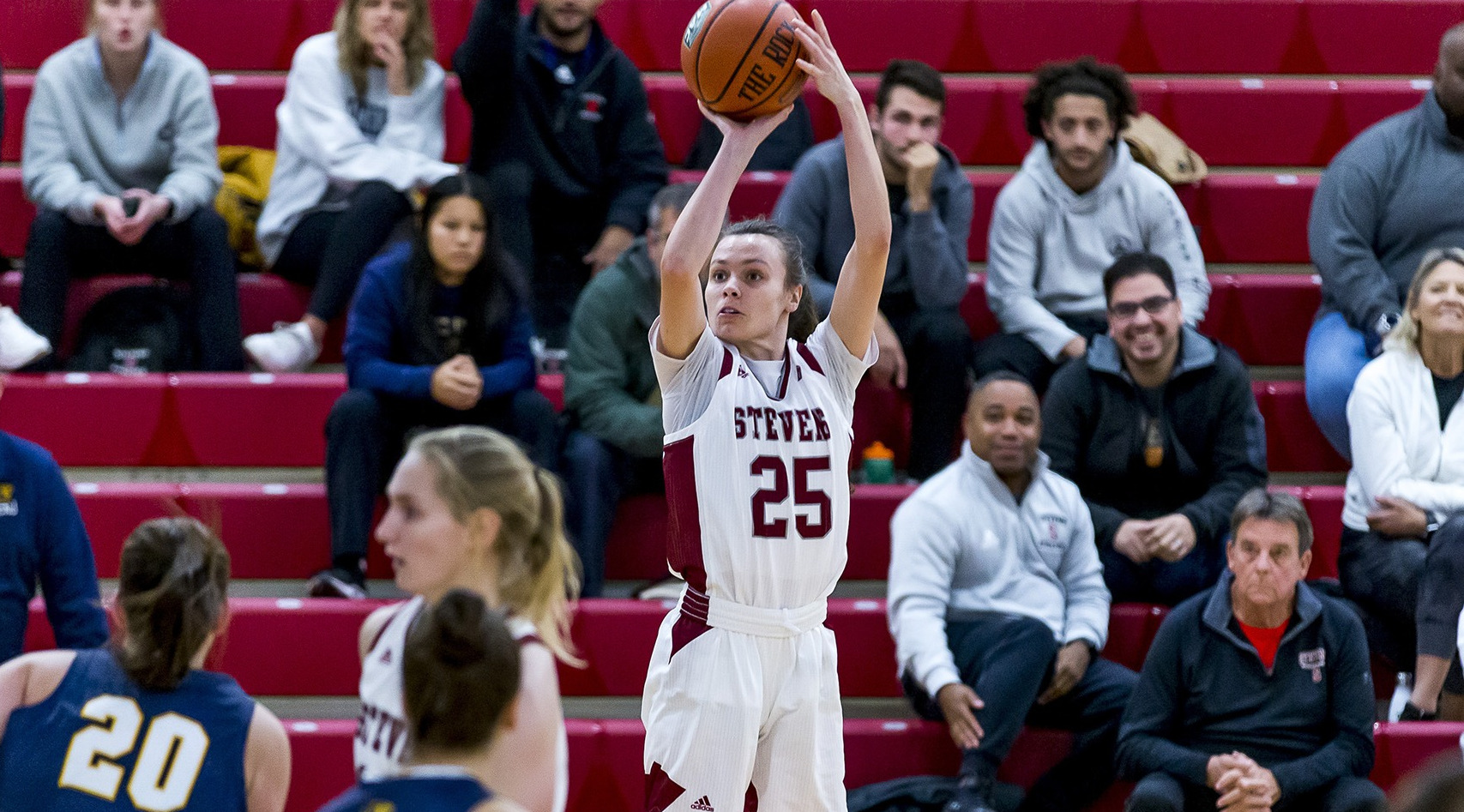
| Stevens was stuck at the table for the entire at-large selection process last season. We think they're luckier Ducks this time. Photo by Stevens athletics |
Our mock selections are a team effort. Scott Peterson, Riley Zayas, and Gordon Mann walked through the process on Sunday's Hoopsville Selection Special, with Dave McHugh serving as moderator and guide. Pat Coleman and Ryan Scott handled the bracketing.
Remember that these picks do not influence the NCAA Tournament selection committee's picks, nor does our Top 25 poll. Geography also does not determine which teams make the Tournament, though it definitely impacts where they play. Those are the most common misconceptions for this process.
- NCAA Selection Show, 2:30 p.m. ET
- Who's in automatically: 44 conference winners
- NCAA tournament FAQs
We start by projecting the regional rankings for each of the ten regions in Division III basketball because that's how the process works. The regional advisory committees that have been producing regional rankings do it one more time and then send them to the national tournament selection committee. That committee can adjust the regional committees' selections, which then alters which teams are regionally ranked, which then changes some teams' records against regionally ranked opponents (one of the primary criteria for selecting at-large teams).
Compared to Wednesday’s regional rankings, we only had a couple of adjustments and the most important are in two reginos.
- Region 6: As is so often the case, we have a hard time predicting where the regional ranking committee will place Emory, which is the only UAA team in this region. We think moved Emory (which went 1-0 with a win over Rochester this week) moves ahead of Randolph-Macon (which went 0-1 with a loss to Shenandoah). That will be important later.
- Region 10: Surprise ASC champion Texas-Dallas moves into our regional rankings, replacing UC Santa Cruz. That doesn’t matter for the Comets because they have the AQ, but it helps the teams that beat them including Hardin-Simmons, Transylvania, and Johns Hopkins. And it hurts East Texas Baptist which lost three times to UTD. That becomes important later, too.
When we get picks wrong, it’s usually right here. Someone we like drops in the regional rankings and never gets to the table for at-large consideration and someone else we didn’t really consider shoots up in the rankings and gets a bid.
Eventually the national committee ends up with a final set of regional rankings, which we should see after the bracket is released. Those rankings include teams that have clinched automatic bids, which are set aside for the bracketing stage. Then the highest ranked team without an AQ within each region comes to the table for consideration as an at-large candidate. There are 10 teams up for consideration at any point, one from each region. We think the first 10 teams up go like this, listed by region.
Round 1: Trinity (Conn.), Babson, Ithaca, Stevens, Elizabethtown, Mary Washington, Baldwin Wallace, Chicago, UW-Oshkosh, Hardin-Simmons
When a team is picked, the next highest ranked team within that region comes to the table. Do that 19 times, add those teams to the 44 automatic bid winners (plus one Pool B bid) and you have your bracket. The Committee selects the participants and then brackets them. It doesn’t just pick a team because it slots into a bracket better than another with a better resume.
Before that though, we have one Pool B bid to award. After a couple years absence, we have this bid reserved for teams without a conference or those whose conference does not have an automatic bid. That’s the newly formed Collegiate Conference of the South, and Berea won the CCS regular season and tournament title. So, the Pioneers are an easy selection.
Now back to the Pool C at-large bids. The first couple choices are easy, meaning you could take them in a different order and it wouldn’t impact the result too much.
Round 1: Trinity (Conn.), Babson, Ithaca, Stevens, Elizabethtown, Mary Washington, Baldwin Wallace, Chicago, UW-Oshkosh, Hardin-Simmons
Every team has a great resume at this point, but Chicago has a win over a No. 1 regionally ranked team (Region 4’s New York University). The Maroons go first and are replaced by UAA travel partner Washington U.
Round 2: Trinity (Conn.), Babson, Ithaca, Stevens, Elizabethtown, Mary Washington, Baldwin Wallace, Washington U, UW-Oshkosh, Hardin-Simmons
Trinity was stuck at the table last year, but not this time. The Bantams, who have a head-to-head win over Babson, are selected early in the process. NESCAC mates Amherst come to the table with a decent strength-of-schedule (SOS) but a relatively low winning percentage.
Round 3: Amherst, Babson, Ithaca, Stevens, Elizabethtown, Mary Washington, Baldwin Wallace, Washington U, UW-Oshkosh, Hardin-Simmons
Let’s fast forward through a few picks since we think these teams are safely into the Tournament. We go with Babson (replaced by Eastern Connecticut in Region 2), Baldwin Wallace (replaced by Marietta in Region 7), Hardin-Simmons (replaced by East Texas Baptist in Region 10), and Ithaca (replaced by SUNY New Paltz in Region 4)
Round 7: Amherst, Eastern Connecticut, SUNY New Paltz, Stevens, Elizabethtown, Mary Washington, Marietta, Washington U, UW-Oshkosh, East Texas Baptist
This brings us to one of our big thematic challenges. How do you handle a team with a relatively low winning percentage but a strong SOS and a lot of wins over regionally ranked opponents (vRRO)? When the NCAA announced its Top 16 teams about 10 days ago, the Committee showed it looks favorably on teams with this profile. Washington U was in the Top 16 with a 16-6 record and an 8-2 vRRO. The Bears’ resume has lost a little luster after going 1-2 since then, but not so much that we don’t think the Bears aren’t safely into the Tournament. They go next and Augustana takes their place.
Rounds 8 and 9 Amherst, Babson, Ithaca, Stevens, Elizabethtown, Mary Washington, Baldwin Wallace, Augustana, UW-Oshkosh, Hardin-Simmons
Eastern Connecticut and Etown sport winning percentages over .800 and solid SOS numbers. They have very similar vRROs and we couldn’t differentiate between them. So, we take them both in some order, and Springfield and Johns Hopkins take their places. SUNY New Paltz also gets a look here, but the Hawks have two wins versus regionally ranked opponents and it’s the same one twice (Cortland). They stay at the table for now.
Rounds 10 and 11: Amherst, Springfield, SUNY New Paltz, Stevens, Johns Hopkins, Mary Washington, Marietta, Augustana, UW-Oshkosh, East Texas Baptist
WashU’s inclusion in the Top 16 wasn’t the only hint that this Committee likes a strong SOS. UW-Whitewater sits atop Region 9 rankings with a similar profile. The Warhawks won the WIAC’s automatic bid so they’re not in this discussion, but UW-Oshkosh is. Similar to WashU, we think the Titans’ strong SOS offsets the relatively low winning percentage and take the Titans. UW-Eau Claire comes to the table for a hot second and goes next. They could even go in the opposite order if the Blugolds hopped over the Titans in the final Region 9 rankings. Whichever order they go, Wartburg takes their place.
Round 12: Amherst, Springfield, SUNY New Paltz, Stevens, Johns Hopkins, Mary Washington, Marietta, Augustana, Wartburg, East Texas Baptist
We like Marietta’s well-rounded resume -- good winning percentage, strong SOS and a win over a team ranked No. 1 in its region (Ohio Northern). The OAC is a three-bid league again with the Pioneers joining Baldwin Wallace and AQ holder Ohio Northern. Calvin comes to the table representing Region 7.
Round 13: Amherst, Springfield, SUNY New Paltz, Stevens, Johns Hopkins, Mary Washington, Trine, Augustana, Wartburg, East Texas Baptist
Now, we go back to SUNY New Paltz. As we mentioned before, the Hawks have a similar resume to Elizabethtown and Eastern Connecticut which are already in the Dance. The vRROs aren’t overwhelming but the winning percentage is relative to everyone else. They go next and Rochester takes their place.
Round 14: Amherst, Springfield, Rochester, Stevens, Johns Hopkins, Mary Washington, Trine, Augustana, Wartburg, East Texas Baptist
Last season we think Stevens sat at the table for the entire process. Region 4 did not get an at-large bid. The Ducks are rewarded this time for scheduling a tough out-of-conference slate that offsets the MAC Freedom’s low SOS. Hop out of the pool and waddle on down, Ducks. Misericordia takes your place.
Rounds 15 and 16: Amherst, Springfield, Rochester, Misericordia, Johns Hopkins, Mary Washington, Trine, Augustana, Wartburg, East Texas Baptist
Trine has a well-rounded resume that’s comparable to Johns Hopkins and Mary Washington. The Thunder were 5-5 versus regionally ranked opponents while JHU was 2-5. That puts Trine into the Tournament (Calvin takes their place), followed by Johns Hopkins (Catholic takes their place).
Round 17: Amherst, Springfield, Rochester, Misericordia, Catholic, Mary Washington, Calvin, Augustana, Wartburg, East Texas Baptist
With Johns Hopkins off the board, that clears the way for Mary Washington. Again, geographic distribution is not a factor in awarding at-large bids. But this does give every region one at-large bid this year.
Round 18: Amherst, Springfield, Rochester, Misericordia, Catholic, Emory, Calvin, Augustana, Wartburg, East Texas Baptist
We’ve got two picks left, and this is where it gets really hard. Remember how we said shifting Emory in front of Randolph-Macon would make a difference? Here it is – we have Emory at the table instead of Randolph-Macon but only for a second. They have a .627 SOS that pops off the page and the Eagles go next. One year after not receiving any at-large bids, the UAA has three this time.
Round 19: Amherst, Springfield, Rochester, Misericordia, Catholic, Randolph-Macon, Calvin, Augustana, Wartburg, East Texas Baptist
At this point, let’s winnow the field down to a couple options, and then do the best we can. We’ll remove Springfield (head-to-head loss to Amherst), Rochester (low winning percentage), Misericordia (low SOS), Calvin (even lower SOS), Catholic (one win against regionally ranked opponents), Wartburg (ditto) and Augustana (similar resume to Misericordia).
That leaves us with East Texas Baptist, Randolph-Macon and Amherst. We’re splitting Tiger hairs, Yellow Jacket wings and whatever Mammoths have.
We’re reminded that Randolph-Macon beat UW-Oshkosh back over the holidays. That’s a better win over a regionally ranked opponent than East Texas Baptist or Amherst have. East Texas Baptist is weighted down by the three losses that Texas-Dallas added by entering the final Region 10 rankings. Amherst is weighted down by the low winning percentage. And there’s always the chance that Randolph-Macon did not slide behind Emory and has already come and gone. And we’re many times-bitten-very-shy when it comes to missing ODAC at-large selections in prior years.
Randolph-Macon gets the last pick, Guilford comes to the table as the lights are turned out, and we move to bracketing.
If you watched Hoopsville, you’ve already seen our bracket. It looks like this.
Bracket 1
at Smith: Mitchell at Smith; Stevens vs Cortland
at Loras: St. Norbert at Loras; Hardin-Simmons vs. Gustavus Adolphus
at Tufts: Morrisville State at Tufts; Eastern Connecticut vs. Marymount
at Trinity (Conn.): Maine Maritime at Trinity; Messiah vs. St. John Fisher
We’re leaning heavily on the Top 16 announcement from a few weeks ago. Smith is the top seed in this quadrant and maybe the whole bracket. Tufts and Trinity get to host as the Top 16 reveal suggested they would. We want to avoid an all-New England quadrant and we want to avoid Hardin-Simmons versus Trinity (Texas) yet again. We fly the Cowgirls to Iowa to play Gustavus Adolphus and whomever wins that pod gets to fly east for the second weekend.
Bracket 2
at Transylvania: Rhodes at Transylvania; Trine vs. Emory
at Hope: Berea at Hope; Baldwin Wallace vs. Millikin
at UW-Whitewater: Knox at UW-Whitewater; Washington U. vs. Webster
at Chicago Northwestern (Minn.) at Chicago; UW-Eau Claire vs. St. Vincent
Transylvania is the top seed in this bracket and the geographic glue that allows us to assemble teams from three regions in one pod. Trine and Emory can both drive to Lexington to play each other. Same goes for Hope, which is within 500 driving miles of Berea (Region 6) and Millikin (Region 8). Washington plays near-neighbor Webster in Wisconsin because we have a sense of humor.
Bracket 3
at Christopher Newport: La Roche at Christopher Newport; Marietta vs. Rowan
at DeSales: Ohio Wesleyan at DeSales; Ithaca vs. Bridgewater State
at SUNY New Paltz: Brooklyn vs. New York University; Randolph-Macon at SUNY New Paltz
at Trinity (Texas): Redlands at Trinity (Texas); Texas-Dallas vs. Whitman
If we understood the NYU broadcasters correctly, they said on Friday's women's broadcast that the Violets can’t host this coming weekend since they don’t have a home gym available. We plant them not too far from home, and SUNY New Paltz hosts. Christopher Newport was a top seed on the road last season, but the women get hosting priority for the first weekend this season. La Roche is one of very few fourth-seeds that can drive to CNU. Redlands and Whitman get the Texas trip that west coast teams usually get in the NCAA Tournament. At least there are no first round rematches, though Whitman/Redlands in the second round would be.
Bracket 4
at Scranton: St. Joseph (Maine) at Scranton; Washington & Lee vs. Roger Williams
at Ohio Northern: Greensboro at Ohio Northern; UW-Oshkosh vs. Gettysburg
at Babson: Notre Dame (Md.) at Babson; Elizabethtown vs. Mary Washington
at Rhode Island College: Merchant Marine at Rhode Island College; Skidmore vs. Johns Hopkins
Ohio teams have the same geographic-glue quality as Transylvania, and ONU allows us to bring UW-Oshkosh and Gettysburg together for a fun (and very low scoring) first round matchup. Rhode Island College might be a bit of a surprise since the Anchorwomen have sailed off the radar much of this season. But RIC is a higher seed within its region than Skidmore and Johns Hopkins. Scranton’s the top seed in this bracket and, if the Lady Royals win the first two rounds, they get to host a Sweet 16 without multiple NESCAC teams being involved.